- New


The essential mechanical upgrade for high-resolution planetary astrophotography
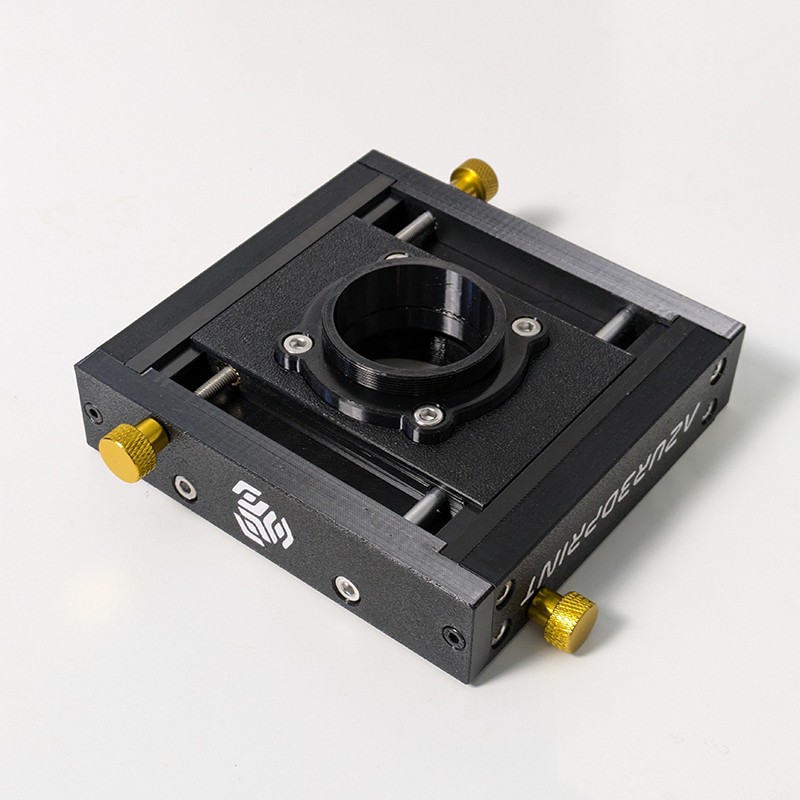
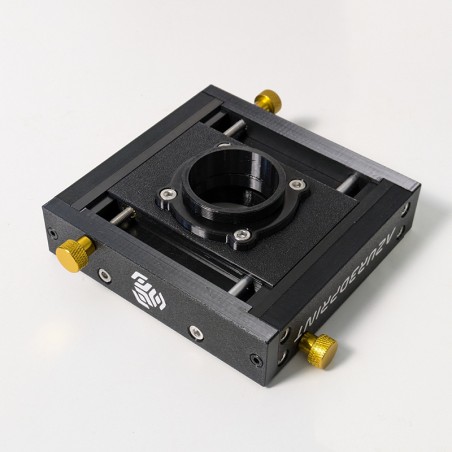
A realistic, robust, and affordable solution to meet the demanding challenges of planetary, lunar, and solar photography at high focal lengths. Originally popularized for hunting guide stars in deep-sky configurations, the X-Y centering plate concept has been thoroughly adopted by advanced planetary imagers. It fixes two major field issues: precision targeting on modern tiny sensors and preserving the optical "sweet spot" on Schmidt-Cassegrain telescopes (SCT). Our plate adapts this proven principle into an optimized field-grade layout, offering a clever alternative to overpriced metrology lab gear.
1. Backlash-free targeting in tiny ROIsAt large resulting focal lengths (using Barlow lenses, extensions, or native SCT setups), tracking a planet directly into a small-field sensor frame via a hand controller is tedious. One wrong tap, and the target flies out of view. This plate allows you to manually soften and tweak X/Y positioning right at the camera body, making it a breeze to use software ROI (Region of Interest) modes to lock down maximum frames per second (FPS). |
2. Preserving the peak sweet-spot (SCT Scopes)During meridian flips or extended tracking tracking, SCT primary mirrors (C8, C9, C11, C14...) inevitably tilt under their own mass (mirror shift). This micro-movement pushes the pristine collimation sweet-spot right off your sensor. Instead of launching into stressful secondary mirror screw tweaking in the dark, this X-Y plate mechanically shifts the camera back into the sweet-spot between turbulence windows. |
Let's be completely transparent: this is not a laboratory-grade metrology stage costing hundreds of dollars. Unloaded, the system displays minor structural tolerances. However, its magic shows under real imaging loads: once your optical train is fully attached (tested and field-proven under the payload weight of cooled cameras, filter wheels, or ADCs), this micro-play is naturally countered by gravity. Axis translation then runs perfectly steady, linear, and free of differential flexure during adjustment adjustments.
To slip cleanly into your imaging stack without stacking unnecessary metal adapters (which introduce unwanted sensor spacing), the plate features standard M42 (42mm x0.75) threads and comes in three clear thread patterns:
• Option A: M42 Female Input / M42 Female Output — Standard (Recommended: Perfect for using your own metal male-to-male couplers or extension tubes, while fully protecting the composite threads from wear).
• Option B: M42 Male Input / M42 Male Output
• Option C: M42 Female Input / M42 Male Output
💡 Azur3dprint's Pro Advice for an Indestructible Rig: "Machining tolerances on metal M42 threads vary wildly across the industry (especially on hardware from ZWO, TS-Optics, or Baader). For a rock-solid, lifetime integration, I highly recommend semi-permanently installing metal M42 adapter rings inside the composite threads of the plate before screwing in your spacers or cameras. Once these metal adapter rings are locked tight into the polymer, your interface becomes bulletproof. This yields two major benefits: you bypass factory thread slop entirely, and you fully protect the composite matrix from stripping due to repeated field assemblies."
— Vincent, Founder of Azur3dprint

Data sheet