
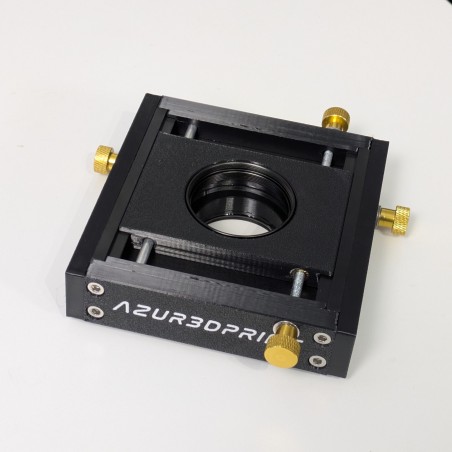


Tame the elusive Sweet Spot of your H-alpha solar filters and optimize high-resolution framing.
Special Solar H-Alpha Sweet Spot Tuning & High-Resolution Planetary Framing Stage
Whether in solar photography or high-resolution planetary imaging, achieving perfect mechanical alignment between your camera sensor and the optimal optical axis is a constant challenge. Our hybrid metal-polymer orthogonal X-Y centering plate provides a highly precise, robust, and affordable hardware response to overcome the optical limitations of your telescope setup.
Narrowband solar filters (such as the Sky-Watcher HelioStar hélioscope, DayStar Quark H-alpha eyepieces, or Lunt systems) inherently suffer from bandpass shift across the field of view. The maximum contrast zone—the famous "Sweet Spot" where chromospheric details pop—is a tiny, restricted area. Unfortunately, due to manufacturing tolerances, this sweet spot is almost never perfectly aligned with your camera sensor's mechanical center.
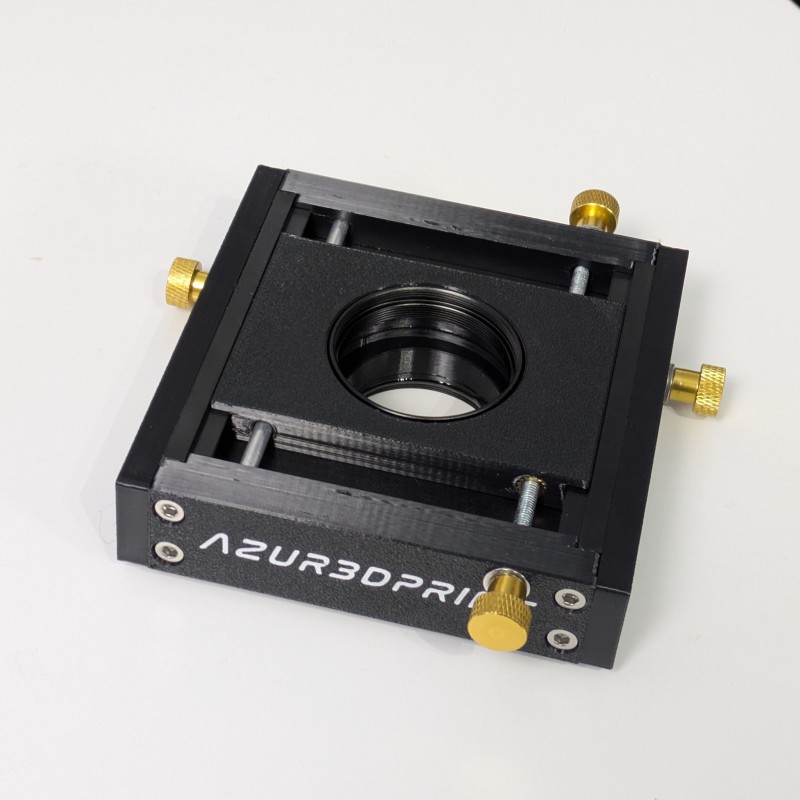
The Solution: Instead of off-centering your equatorial mount (which throws your target off-frame) or tilting the optical train (which introduces focal plane tilt and astigmatism), our X-Y plate lets you mechanically slide your sensor to pinpoint the exact transmission peak of your filter. You instantly unlock the full contrast of the chromosphere, capturing pristine solar prominences, filaments, and active regions with breathtaking contrast.
1. Backlash-Free Centering in Small ROIsAt long focal lengths (using Barlow lenses, extensive extensions, or native SCT setups), positioning a planet or a lunar crater dead center on a tiny sensor is incredibly tedious using a mount hand controller. This plate lets you manually and smoothly tweak X/Y positioning directly at the camera, making it incredibly easy to utilize small ROI (Region of Interest) modes to maximize your software FPS. |
2. SCT Primary Mirror Shift CompensationDuring meridian flips or tracking tracking, Schmidt-Cassegrain primary mirrors (C8, C9.25, C11, C14...) inevitably tilt under gravity (mirror shift), displacing the optimal collimation sweet spot off your sensor. Our X-Y plate lets you slide your camera back into the peak optical axis in seconds, saving you from doing a stressful secondary mirror collimation in the middle of the night. |
Let's be completely transparent: this is not a laboratory-grade metrology stage costing hundreds of dollars. Unloaded, the system displays minor structural tolerances. However, its magic shows under real imaging loads: once your optical train is fully attached (tested and field-proven under the payload weight of cooled cameras, filter wheels, or ADCs), this micro-play is naturally countered by gravity. Axis translation then runs perfectly steady, linear, and free of differential flexure during adjustments.
To confidently support heavy imaging trains without a hint of sagging, we completely eliminated printed plastic threads:
• Epoxy-Bonded Aluminum Inserts: Precision-machined M42 aluminum rings (5mm thread depth) are structurally bonded with heavy-duty dual-component epoxy into the high-density PETG chassis. You get a wear-free, professional metal interface that stands up to constant setup changes on the field.
• Ultra-Slim 30.5mm Profile: This low-profile hybrid integration keeps the physical thickness down to just 30.5 mm (in Male/Female configuration). This preserves your precious backfocus, ensuring you reach focus easily behind diagonal mirrors or solar hélioscopes (such as the Sky-Watcher HelioStar).
To slip cleanly into your imaging stack without stacking unnecessary metal adapters, the plate features standard M42 (42mm x0.75, 5mm thread height) threads and comes in three clear patterns:
• Male / Female Option (Slim 30.5 mm optical thickness)
• Male / Male Option
• Female / Female Option
💡 The Astronomer's Advice: "Solar astrophotographers often spend hours trying to figure out why their H-alpha images lack uniform contrast. Once the camera is shifted just a few millimeters using our micrometric X-Y knobs to intersect the peak bandpass of the etalon, the leap in contrast is spectacular. While slight mechanical play exists when unloaded, gravity fully stabilizes the stage the second it holds your camera and imaging accessories."
— Vincent, Founder of Azur3dprint

Data sheet
Tame the elusive Sweet Spot of your H-alpha solar filters and optimize high-resolution framing.