
Every instrument has its own quirks. Whether you’re using a refractor, a Newtonian, an RC, or even a camera lens,...
🌟 Welcome Offer / Offre de Bienvenue! 🎁
Latest posts
-
 How to Choose the Right Bahtinov Mask for Your TelescopeVoir plus
 -
 Meet Elsasstronomy: A French YouTuber Passionate About the StarsVoir plus
Have you heard of the YouTube channel Elsasstronomy? No? Then you’re missing out! After reading this interview, we...
-
 Bahtinov Masks Explained: How to Master Sharp FocusVoir plus
What is a Bahtinov mask? How do you use it? And what’s the difference between a Bahtinov and a Tri-Bahtinov? Let’s...
-
 Why This Blog ExistsVoir plus
Curious why this blog exists and what you’ll discover here? Let me explain…
Blog categories
Search in blog
Archived posts
Bahtinov Masks Explained: How to Master Sharp Focus
Hello everyone! Today, let’s talk about a must-have accessory for sharp, precise images of the night sky: the Bahtinov mask.
What exactly is a Bahtinov mask? How do you use it? And what’s the difference between the Bahtinov and the Tri-Bahtinov? Let’s explore these questions together.
Why this name?
The Bahtinov mask is named after its inventor, Pavel Bahtinov, a Russian amateur astronomer. While improving on the older Hartmann mask design, he discovered that replacing Hartmann’s triangular openings with carefully arranged slits produced a much clearer diffraction pattern—making fine focus far easier.
He shared his idea on a Russian astronomy forum in 2005, and it was quickly adopted by the community. The mask has carried his name ever since.
For a deeper theoretical explanation, check out this excellent article (in French) from the Société Astronomique du Havre: https://sahavre.fr/wp/masque-de-bahtinov/
So, what is a Bahtinov mask?
A Bahtinov mask is a plate that attaches to the front of your telescope or refractor, usually on the dew shield.
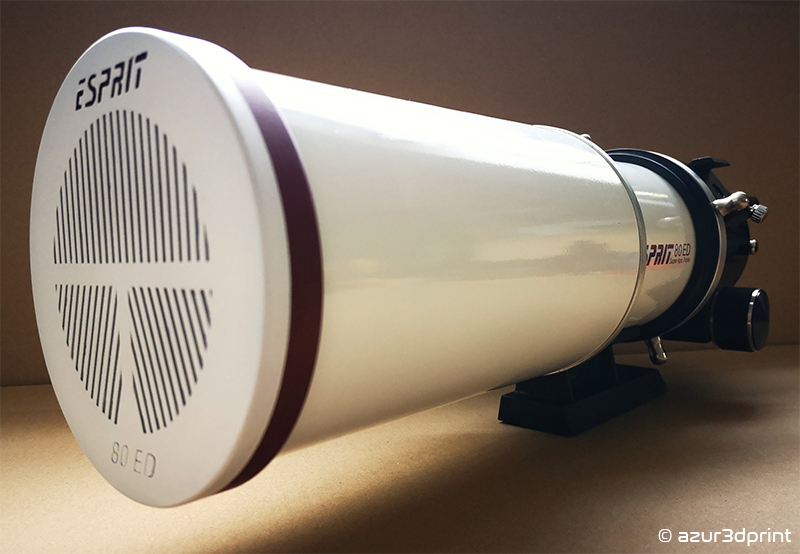
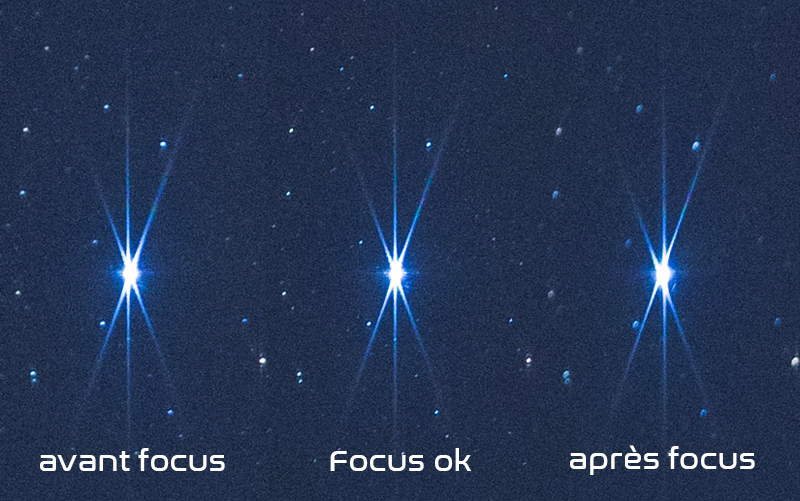
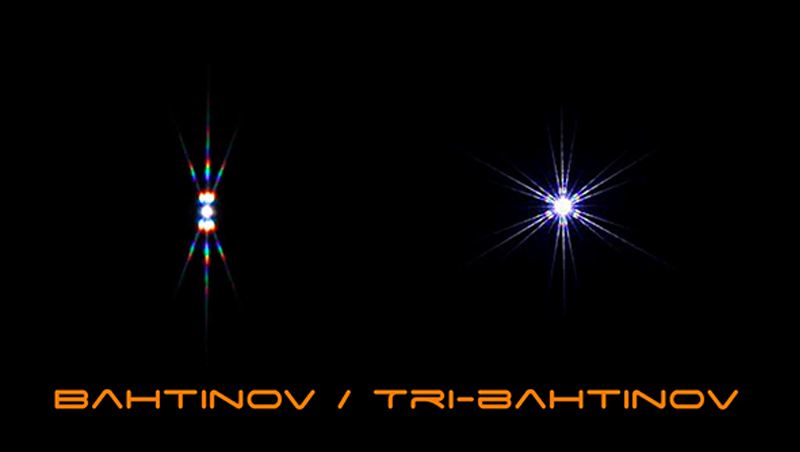
The slits cut into the mask generate a diffraction pattern when pointed at a bright star. This pattern makes it easy to see whether your focus is spot-on or needs adjusting.
When focus is correct, the diffraction spikes align symmetrically across the star. If not, they appear shifted or distorted.
How do you use a Bahtinov mask?
Using one is simple: place the mask securely in front of your telescope, aim at a bright, isolated star, and look through your eyepiece or camera. Adjust the focus knob until the central diffraction spike is perfectly aligned with the others. That’s when your focus is at its best.
Bahtinov vs. Tri-Bahtinov
While the classic Bahtinov mask produces three intersecting diffraction spikes, the Tri-Bahtinov takes things further.
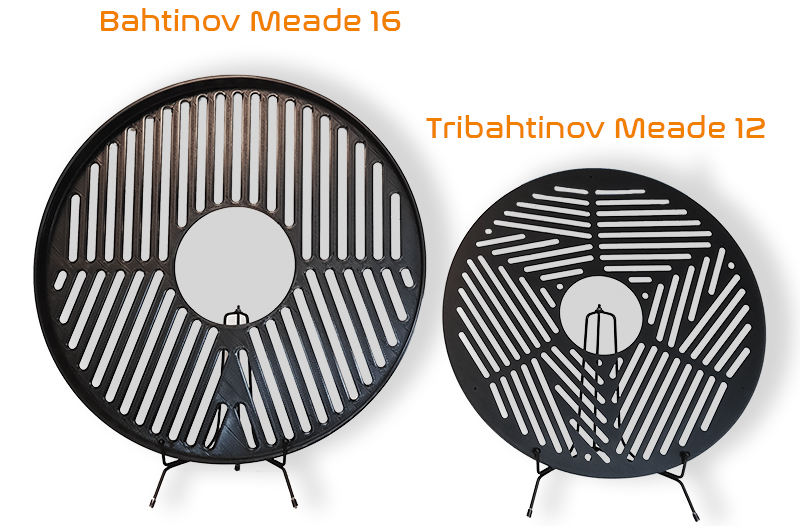
The Tri-Bahtinov is divided into three zones, each creating its own diffraction pattern. This not only refines focus but also helps check collimation. With good collimation, all six spikes are evenly spaced; with poor collimation, the pattern appears irregular or offset.
Originally designed for Schmidt-Cassegrain telescopes, the Tri-Bahtinov can also be used with Newtonians, Ritchey-Chrétiens, Maksutovs, and more.
For more insights, check out this excellent CloudyNights thread: Comparing Tri-Bahtinov Mask and Airy Disk for SCT Collimation
Pros & Cons
Bahtinov and Tri-Bahtinov masks are highly appreciated by astrophotographers for several reasons:
- ✅ Easy to use and install
- ✅ Provide quick, precise focus
- ✅ Affordable and available in many sizes
Of course, there are also a few drawbacks:
- ❌ You must remove the mask before taking your final photo—otherwise you’ll end up with “artistic” but unintended spikes ?

- ❌ Depending on the material, some masks can be bulky or fragile (anyone who’s used acrylic ones knows what I mean ?)
I hope this article has shed some light on the usefulness of Bahtinov and Tri-Bahtinov masks. If you’re looking for one, you’ll find models for most common instruments in our shop. And if your telescope isn’t listed—just ask, we’ll be happy to create one for you ?
Clear skies and happy observing!
Posted in:
A quoi ça sert?
Related posts
-
How to Choose the Right Bahtinov Mask for Your Telescope
Every instrument has its own quirks. Whether you’re using a refractor, a Newtonian, an RC, or even a camera lens,...Voir plus
Leave a comment
Comments
Bahtinov et Tri-Bahtinov.
By: Jean-Mario Charest On 2025-06-06Bonjour, j'ai quelques instruments de Bresser.
Un 127mm Maksoutov-Cassegrain.
Un 152mm Maksoutov-Cassegrain.
J'aimerai, obtenir, un Bahtinov et un Tri-Bahtinov.
Pour mes deux instruments.
Faut-il que je vous donne les dimensions extérieur pour ces deux instruments?
Merci de me répondre,
Replied by: Vincent DUCHENE On 2025-06-08